











Alphonse Mucha "Les Saisons (The Seasons)" Lithographs
The Seasons (Les Saisons) by Alphonse Mucha is among the most celebrated expressions of Art Nouveau printmaking: a suite of four poetic lithographs—Spring, Summer, Autumn, and Winter—each allegory embodied by an idealized female figure adorned with the flora and fauna of their eponymous season.
Spring (Les Printemps) Spring emerges as an ethereal, blonde sylph—an air elemental—standing before a haze of apple blossoms. She is framed by a delicate wreath of blooming dogwood, a motif Mucha studied from life. She fashions a lyre-like instrument from a fresh green branch, her own flowing hair forming its strings, evoking the poetic ideal of the Aeolian harp—an instrument played not by human hands but by the wind itself. This association aligns her with Romantic notions of nature as an animating force, written by contemporaneous poets such as Samuel Taylor Coleridge. At her feet, songbirds—including the ortolan bunting, long associated in French culture with innocence, and the exotic red-billed leiothrix, prized for its melodious song—gather to animate the composition with sound. The floral border of her garment, composed of narcissi, asters, dianthus, and cuckoo flowers, reinforces the sense of the abundance that defines the season.
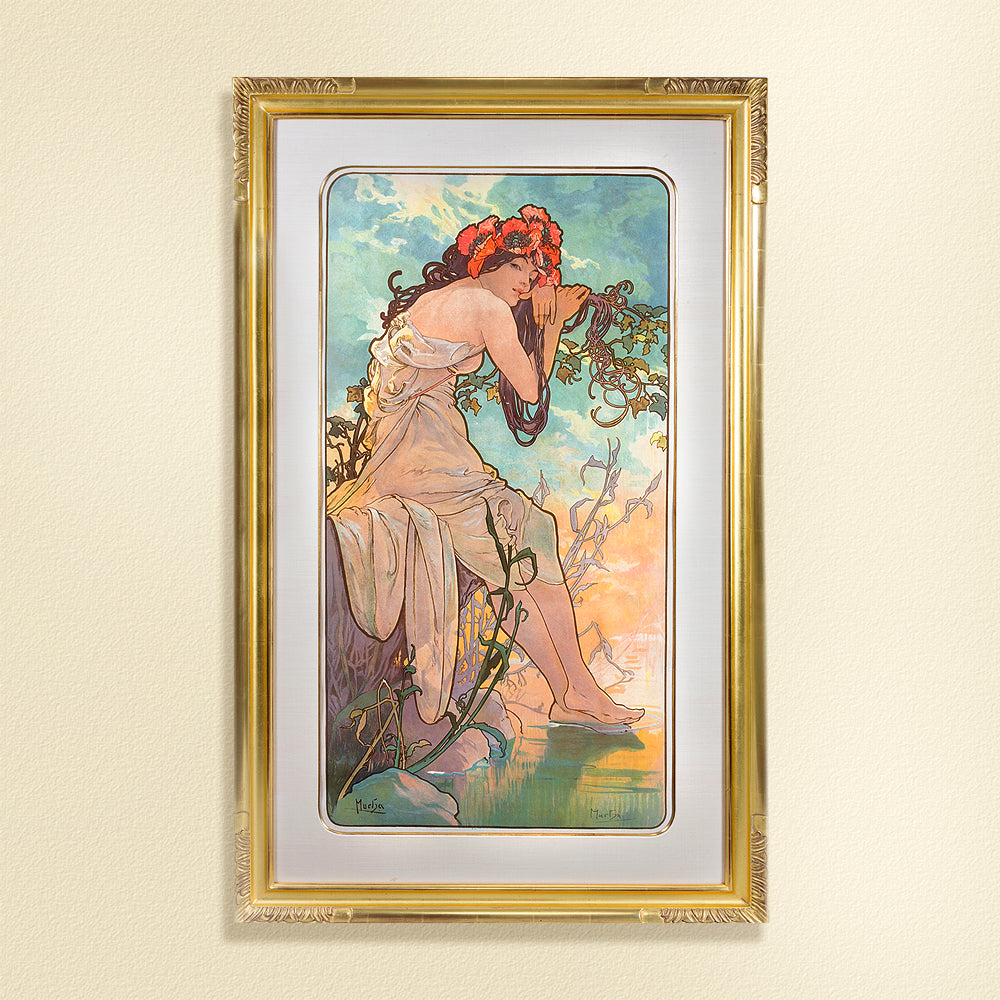
Summer (L’Été) Summer is rendered in languid repose, seated beside a reflective pool, her body slackened by the heat. Crowned with vivid red poppies—flowers of both sleep and sensuality—she dips her feet into cool water, seeking relief from the oppressive warmth. Ivy curls around her form, her translucent white drapery appears to slip from her shoulders, heightening the sense of languor. Unlike the airiness of Spring, Summer is grounded in the body, evoking the sensuous, almost narcotic stillness of a long, sun-drenched afternoon.
Autumn (L’Automne) Autumn is richly adorned, her deep auburn hair echoing the tones of fallen leaves that surround her. She turns her gaze not outward, but toward the ripe grapes she holds—a symbol of harvest and abundance. A crown of chrysanthemums, rendered in white and blue, rests upon her head, a flower closely associated with Mucha himself, who was known—according to his son Jiří Mucha—to wear one in his buttonhole. Her costume is elaborately detailed with filigree disk brooches inspired by the stage jewelry of Sarah Bernhardt, particularly in her role as Theodora. These jewelry designs by Mucha drew on historical sources ranging from Byzantine mosaics studied in Ravenna to the earlier Merovingian traditions of Frankish and Lombardic women, who wore paired brooches to fasten their garments.
Winter (L’Hiver) Winter is the most introspective and enigmatic of the four. Wrapped in a heavy blue shawl, she is enveloped by bare, snow-laden branches, her palette subdued and shadowed. In her hands she cradles small European robins—known as rouge-gorge familier—birds that introduce a fragile note of life into the frozen stillness. The mood is ambiguous: she may be gently sustaining these creatures through the harsh season, or contemplating survival in a more somber sense. Unlike the outward vitality of the other panels, Winter turns inward, suggesting quiet endurance and the latent promise of renewal yet to come.
Together, these four lithographs form a unified cycle that moves from the awakening of Spring through the sensual fullness of Summer and the reflective abundance of Autumn, into the hushed stillness of Winter. Mucha’s synthesis of natural observation, literary symbolism, and historical reference elevates The Seasons beyond decorative art into a deeply poetic vision of the natural world.
Item #: YML-21438
Artist: Alphonse Mucha
Country: France
Circa: 1897
Dimensions: 47.5" height, 27.5" width (Framed: 50.5" high x 30.5" wide)
Materials: Lithograph paper, Giltwood gesso frame
Signed: Signed, ''Mucha” on all four lithographs, and a personal hand written dedication signed by Mucha on the bottom right hand corner of Spring. The dedication reads: “A Monsieur Georges Deschamps/homage symapthique/Mucha/ Paris 10, Janv. 1897”.
Condition: Posters have recently been sensitively conserved. All lithographs have been laid down on canvas.
Spring: Border with some restoration and in painting. Blemish on left chin, elbow and upper arm. Repaired tear 1" in tree background.
Summer: Border with some restoration and in painting. Slight touch up on bottom center to the shadow cast by her left foot.
Fall: Border with some restoration and in painting. Restored spot in background around hair, and in blue area near ruffle.
Winter: Border with some restoration and in painting.
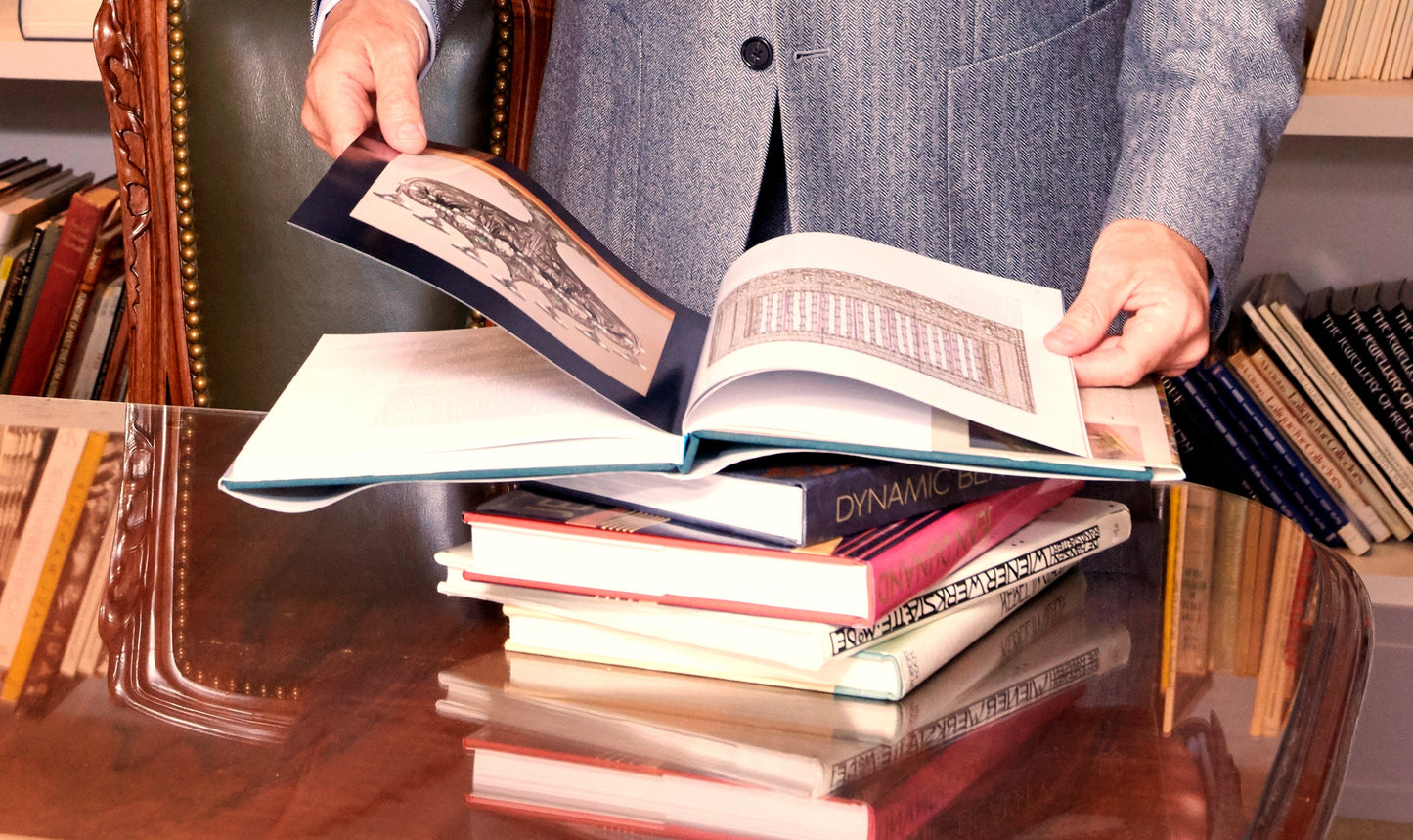
Literature: Pictured in: Alphonse Mucha: The Complete Posters and Panels by Jack Rennert and Alain Weill, G.K. Hall & Co., Publishers, Boston, pages 90-97, cat. 18.
Item #: YML-21438
Artist: Alphonse Mucha
Country: France
Circa: 1897
Dimensions: 47.5" height, 27.5" width (Framed: 50.5" high x 30.5" wide)
Materials: Lithograph paper, Giltwood gesso frame
Signed: Signed, ''Mucha” on all four lithographs, and a personal hand written dedication signed by Mucha on the bottom right hand corner of Spring. The dedication reads: “A Monsieur Georges Deschamps/homage symapthique/Mucha/ Paris 10, Janv. 1897”.
Condition: Posters have recently been sensitively conserved. All lithographs have been laid down on canvas.
Spring: Border with some restoration and in painting. Blemish on left chin, elbow and upper arm. Repaired tear 1" in tree background.
Summer: Border with some restoration and in painting. Slight touch up on bottom center to the shadow cast by her left foot.
Fall: Border with some restoration and in painting. Restored spot in background around hair, and in blue area near ruffle.
Winter: Border with some restoration and in painting.
Literature: Pictured in: Alphonse Mucha: The Complete Posters and Panels by Jack Rennert and Alain Weill, G.K. Hall & Co., Publishers, Boston, pages 90-97, cat. 18.